Why Canadian Creators Need to Register for GST/HST — and Why the CRA Is Increasingly Doing It For You
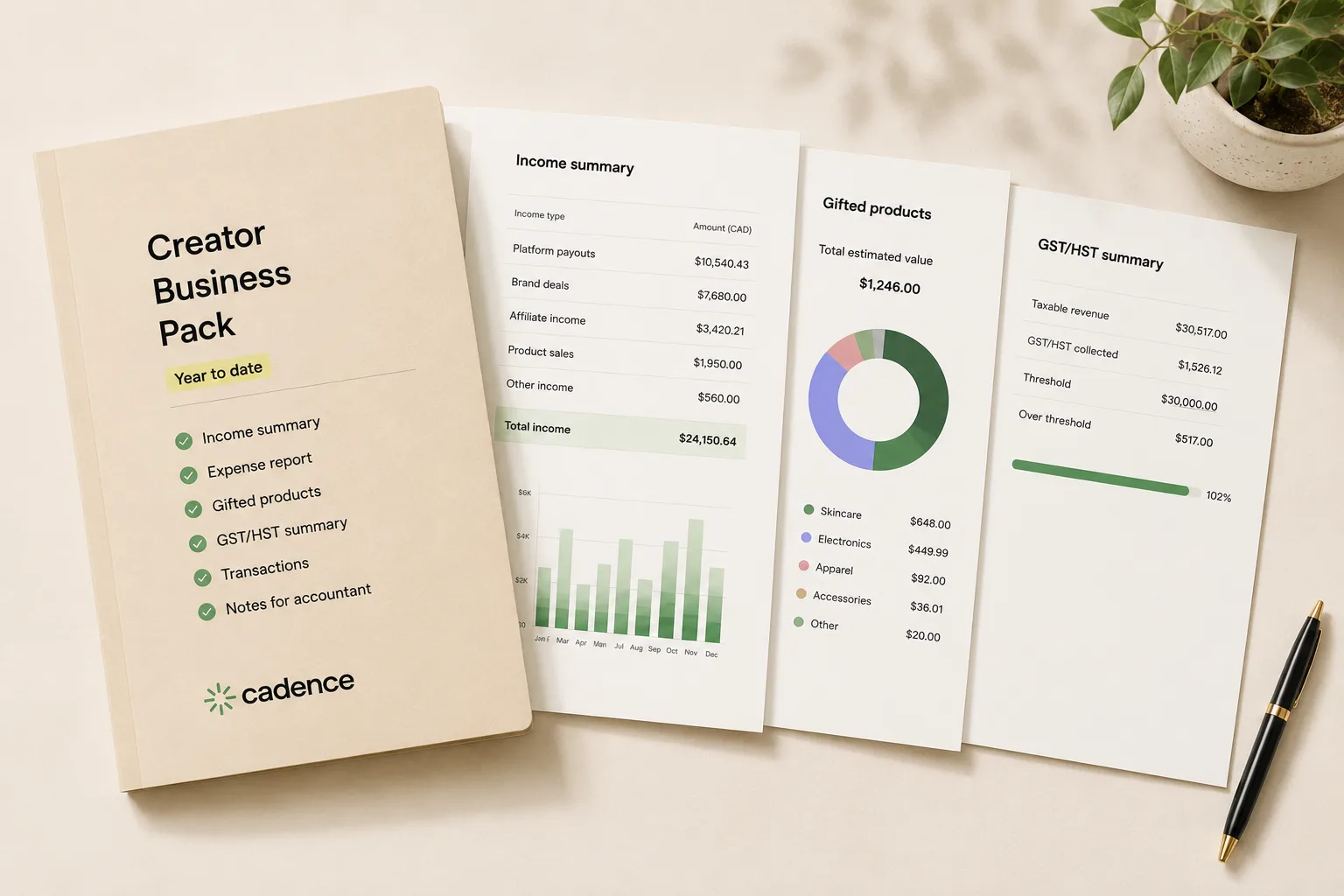
For most of the past decade, GST/HST registration was something Canadian creators could put off until an accountant raised it. That window is closing. The CRA now runs a dedicated GST/HST Non-Registrant Program that reviews T1 returns, T4A slips, invoices and — as of 2024 — detailed earnings data sent in by digital platforms under the new Part XX reporting rules. If the CRA decides you should be registered and you do not respond, it can register you anyway and assign you a GST/HST account whether you asked for one or not. This is a plain guide to why creators are increasingly on that list, what triggers a Notice of Intent, and why getting ahead of it almost always costs less than waiting.
$30K
Small supplier threshold
Worldwide taxable revenue before expenses, tested per calendar quarter and over four consecutive quarters.
Jan 1 2024
Part XX reporting begins
Digital platforms must collect and report seller earnings to the CRA — first returns due Jan 31, 2025.
29 days
Window to register after crossing
From your effective date of registration once you exceed the small supplier threshold.
The CRA's approach to creator income has changed
For years, the practical reality was that small creator payouts from foreign platforms flew under the radar. Brand deals were often paid through PayPal or e-transfer. Gifted product wasn't reported anywhere. The CRA didn't have a reliable way to see most of it.
That has changed in three concrete ways:
- T4A reporting from Canadian agencies and brands is increasingly common — every fee-for-services payment over $500 may show up on a slip in the creator's name
- Part XX of the Income Tax Act now requires digital platforms to report seller earnings directly to the CRA each January for the prior calendar year
- The CRA's GST/HST Non-Registrant Program actively cross-references T1 returns, slips and invoices to identify people who should be GST/HST registered but are not
The net effect: the CRA increasingly knows what a creator earned before the creator's own accountant does, and it knows from multiple sources at once. The agency has explicitly flagged the "platform economy" — including social media influencers — as a compliance focus.
The GST/HST Non-Registrant Program: how the CRA finds you
The Non-Registrant Program is the CRA's own published process for identifying people who have crossed the small supplier threshold without registering. In its own words, the program reviews:
- T1 returns (personal income tax) showing self-employment income
- T2 returns (corporate income tax)
- Invoices on file that show GST/HST collected
- Information slips issued in the taxpayer's name — including T4A (fees for services), T5018 (construction subcontractors) and T5013 (partnerships)
For a creator, T4A is the one that most often surfaces a non-registration issue. Canadian agencies, talent management firms and brands that pay you for sponsored content regularly issue T4A slips with the fee amount in box 048. Once the CRA can see total T4A revenue across multiple payers exceeding $30,000, the file gets routed to a Non-Registrant officer.
The CRA describes the workflow on its GST/HST Registration video transcript — well worth reading once if you want to see exactly how the program describes itself.
What a Notice of Intent to Register looks like
When the CRA decides you should be registered, the standard sequence is straightforward but blunt:
- A Non-Registrant officer first tries to contact you by phone or letter to verify your business activity and income
- If contact is successful and a GST/HST account is needed, the officer gathers the required information and sets up the account; your new business number and registration details are mailed to you
- If the CRA cannot reach you but still has information supporting registration, a Notice of Intent to register is mailed to you
- If you do not consent and do not provide a sufficient reason why you should not be registered, the officer will register you anyway
- You are then notified in writing of your GST/HST number, your effective date of registration, and your obligations for filing and remittance going forward
Part XX: the new digital platform reporting pipeline
The piece that's genuinely new — and the reason 2025 onward looks different from prior years — is the Reporting Rules for Digital Platform Operators under Part XX of the Income Tax Act. These came into force on January 1, 2024. The first information returns were due January 31, 2025, covering the 2024 calendar year.
Reporting platform operators (RPOs) must collect and report, for each "reportable seller" using the platform:
- Full name and primary address
- Date of birth (where applicable)
- Tax identification number (SIN, business number, or foreign equivalent)
- Financial account identifiers (e.g., bank or payment account info)
- Total consideration paid or credited per quarter
- Any fees, commissions or taxes withheld
- The location of rented property, where applicable
Both the CRA and the seller receive a copy of the relevant information. Sellers who refuse to provide their TIN can face a $500 penalty per refusal under the Income Tax Act.
The covered "relevant activities" include the sale of goods, the rental of real property, the rental of transport, and the provision of "personal services" — which is broad enough to capture a wide range of creator and gig work. The rules are essentially Canada's version of the EU's DAC7 framework.
Why creators are now uniquely visible
Creator income concentrates several signals that the CRA's systems are good at picking up:
A creator who earned $18,000 from a Canadian agency (T4A), $14,000 from YouTube (Part XX reporting may apply), and $6,000 from US brand deals (cross-referenced against bank deposits) is sitting at $38,000 of taxable supplies. From the CRA's perspective, all of that is potentially visible without sending the creator a single letter first.
Refresher: the $30,000 small supplier threshold
Registration is generally mandatory once your worldwide taxable supplies before expenses exceed $30,000 either:
- In a single calendar quarter — you are no longer a small supplier on the supply that pushed you over, and must charge GST/HST on it
- Over four consecutive calendar quarters (rolling) — you cease to be a small supplier at the end of the month following the quarter in which you crossed $30,000
Both tests use worldwide taxable revenue. US brand deal income that may be zero-rated for GST/HST purposes still counts toward the threshold — a frequent source of surprise for creators with significant US sponsor income.
You have 29 days from your effective date of registration to register once you cross. The official source is the CRA page on when to register and start charging GST/HST.
What happens when the CRA registers you
Being involuntarily registered by the Non-Registrant Program is not the same as registering yourself. The differences matter:
- Your effective date is set by the officer — usually backdated to when you should have registered, not the date of the letter
- GST/HST is owed on all taxable supplies made after that effective date, even if you never collected it from the customer
- Late-filing penalties and interest can accrue from the effective date forward
- You lose the ability to claim Input Tax Credits on expenses incurred before your effective date, but you can claim ITCs from that date forward — assuming you kept the receipts
- Your filing frequency is assigned automatically (most creators get annual filing, but it depends on revenue)
- You still have to file every period going forward, including nil returns
The financial damage typically isn't a single line item — it's the combination of GST/HST you should have charged but didn't, interest from the date it was owed, and penalties for late filing. On a year with $60,000 of Canadian brand revenue, the underlying tax alone can be over $7,000 before any penalties.
For more on how this plays out under a creator-focused audit, see the CRA creator audit guide.
Why voluntary registration usually beats waiting
The case for registering on your own terms — ideally before you cross the threshold, and almost always once you've crossed — comes down to control:
- You pick the effective date (typically the date of request, or up to 30 days prior), so you avoid surprise backdating
- You can claim Input Tax Credits on GST/HST paid on gear, software, internet, and other business expenses going forward — sometimes thousands per year
- You can update invoice templates and notify brands proactively, so the tax is collected from the customer rather than coming out of your pocket
- You avoid late-filing penalties and interest that would otherwise stack
- You sidestep the optics of a CRA-initiated registration on your account history
The trade-offs are real and worth naming: you must charge GST/HST on every Canadian invoice once registered, you must stay registered for at least one year before cancelling, and you have to file returns on the schedule the CRA assigns. For most creators with regular brand revenue, these are small frictions compared to the alternative.
What to do if you've already crossed the threshold
The worst version of this situation is silence. The CRA is far more lenient with taxpayers who self-correct than with those who wait to be found. If you suspect or know you've crossed $30,000 without registering:
- Pull together the four-quarter rolling totals of your taxable supplies — brand deals (Canadian and foreign), platform payouts, paid subscriptions, digital products, the lot
- Identify the calendar quarter in which the threshold was first exceeded
- Speak to a Canadian tax accountant before contacting the CRA — they can help frame the registration request and consider whether a Voluntary Disclosures Program (VDP) application is appropriate
- Be ready to file the missed GST/HST returns once registered
- Claim every Input Tax Credit you have documentation for from the effective date forward
The Voluntary Disclosures Program (VDP) can in some cases reduce or eliminate penalties for non-compliance, provided the disclosure is voluntary (i.e., the CRA hasn't already started a review of you), complete, and submitted before the CRA contacts you about the issue. The window narrows once a Non-Registrant officer sends a letter.
Records the CRA expects to see
- Quarterly running totals of taxable revenue before expenses, with source notes (brand, platform, agency)
- All brand deal contracts and invoices, with a clear note on GST/HST treatment per invoice
- Platform payout statements (YouTube AdSense, TikTok, Twitch, Patreon, OnlyFans, etc.) for every calendar year going back at least six years
- T4A slips received from Canadian agencies and brands
- Bank statements that match deposited amounts to the invoices that generated them
- Receipts that show the GST/HST line for any expense you want to claim as an Input Tax Credit
- Your GST/HST registration confirmation, effective date and filed returns once registered
For a deeper run-through of the year-end record packet, see what to send your accountant as a creator.
Common creator misconceptions about GST/HST
- “My income is all from US brands so I don't need to worry” — US brand income can be zero-rated, but it still counts toward your $30,000 threshold
- “YouTube AdSense doesn't count because Google handles tax” — Google may handle consumer-side tax in some jurisdictions, but the payout to you can still be a taxable supply for threshold purposes
- “Gifted products aren't income” — fair market value of gifted product tied to content can count as revenue and can push you over the threshold
- “The CRA can't see my Patreon income” — Patreon and similar platforms can fall under Part XX reporting starting 2024
- “If I don't issue an invoice, there's no record” — bank deposits, e-transfers and platform statements are all reviewable on audit
- “I'll register next year when I have time” — the CRA's effective date is the date you should have registered, not the date you got around to it
How Cadence helps
Cadence doesn't register you for GST/HST or file returns for you — that's still your accountant. What it does is keep the picture in front of you so you can see what's coming:
- A live running total of taxable revenue across brand deals, platform payouts and gifted product
- A threshold tracker that flags when you are approaching the $30,000 line, by single quarter and over four rolling quarters
- A GST/HST status field on each brand deal so missed tax is easy to spot
- A clean year-end export your accountant can use to register, back-file, or claim ITCs
Frequently asked questions
Can the CRA really register me for GST/HST without my consent?
What is Part XX reporting and when did it start?
Does YouTube ad revenue count toward my $30,000 threshold?
Do US brand deals count toward the threshold?
What is a T4A and why does it matter for GST/HST?
What happens if I ignore a CRA Notice of Intent to Register?
If I register myself now, can I avoid backdating?
Can I claim Input Tax Credits if I'm registered late?
What is the Voluntary Disclosures Program?
How far back can the CRA go on a GST/HST review?
Do I have to charge GST/HST on every Canadian brand deal once registered?
Where can I read the CRA's official guidance on all this?
A short reading list to share with your accountant
A note on tax content. This article is general information for Canadian creators, not tax advice. Rules change and your situation is specific to you. Use Cadence to keep clean records, then ask your accountant before filing.
CADENCE
Keep payouts, brand deals, gifted products and tax details in one clean creator business record.
14-day free trial · $19/month after · cancel anytime