What to Send Your Accountant as a Creator or Influencer
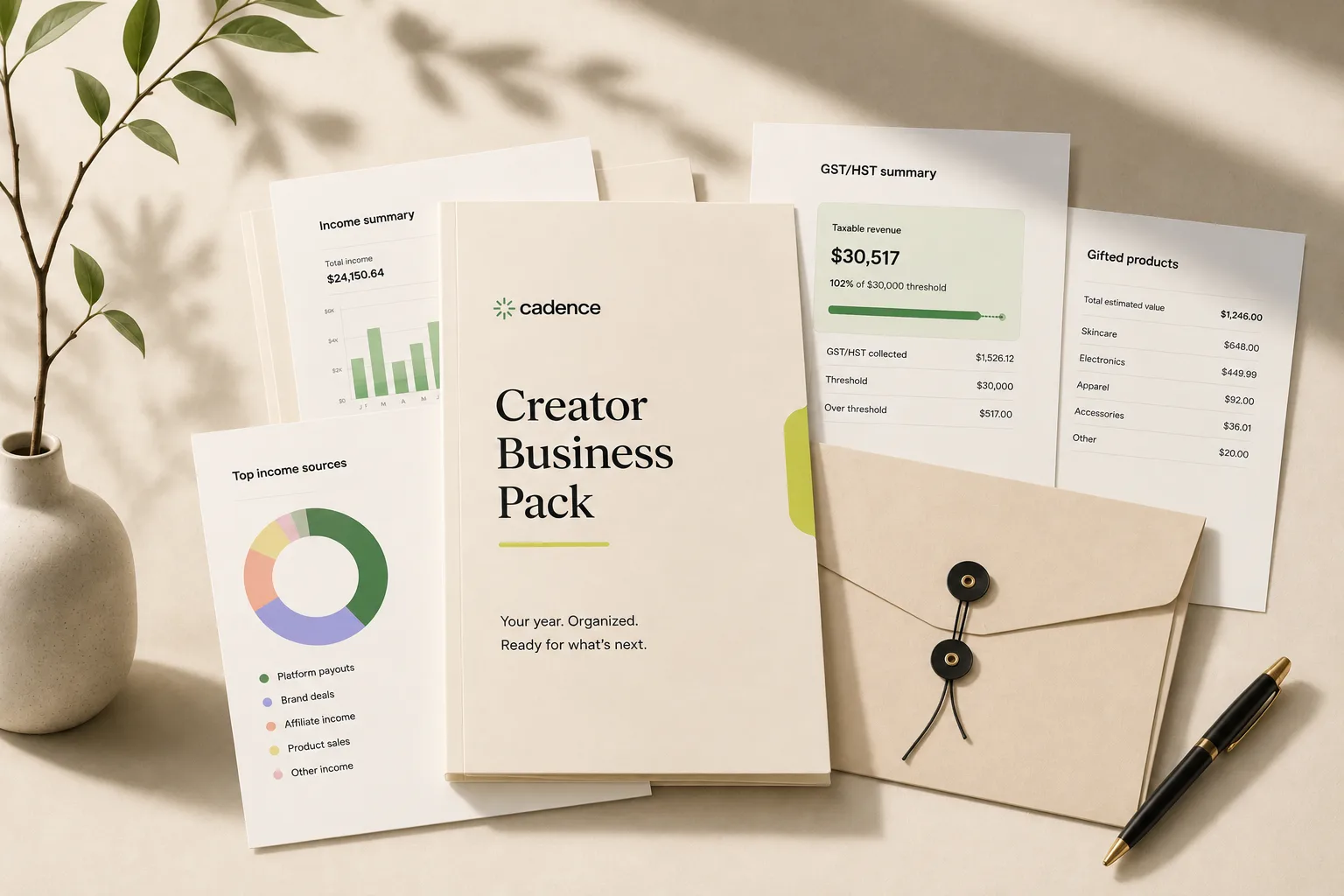
You will usually pay more if you hand your accountant a folder of receipts and a bank statement with no summary. Their job — and your bill — get smaller when you send income by type, with the supporting records linked. This is the handoff list for Canadian creators and influencers on YouTube, TikTok, Instagram, Twitch, Patreon, Substack and brand deals.
Mid-Feb
Target send date
April is busy season — earlier is faster and cheaper.
1 PDF
Summary package
Plus a folder of supporting evidence.
T2125
The form most creators file
Statement of Business or Professional Activities.
The year-end package in seven pieces
Your year-end package is really seven pieces. Send them together so your accountant is not chasing missing numbers in February.
Year-end timeline for creators
A typical year-end handoff looks like this:
- December — close the books, capture last-minute receipts, finalize the gifted product list
- Early January — pull the year's payout reports from each platform (YouTube, TikTok, Twitch, Patreon, Substack, etc.)
- Mid-January — categorize and reconcile, write your questions list
- End of January — issue or chase any outstanding invoices, T4As to contractors paid above the threshold
- Mid-February — send the package to your accountant
- March / April — review and sign filings
- April 30 — personal tax filing deadline (June 15 for self-employed, but balance still due April 30)
Income summary by type
One number for total income is not enough. Break income out by source so your accountant can see the shape of your year:
- Platform payouts (split by platform — YouTube, Twitch, TikTok, Patreon, Substack, Kick, OnlyFans, etc.)
- Brand deals (cash payments, by brand)
- Affiliate commissions (LTK, Amazon Associates, ShareASale, Impact, brand-direct)
- Tips, donations, subs, bits, Stars
- Digital product sales (Gumroad, Stan, Kajabi, Shopify)
- Gifted products (with estimated values, kept separate from cash income)
- Other (reimbursements, rev share, live event income, etc.)
- 45%Brand deals
- 25%YouTube AdSense
- 15%Patreon / Substack
- 10%Affiliate
- 5%Gifted product (FMV)
Platform payout summary
For each platform you earn from, your accountant will appreciate:
- The platform name
- Total gross income for the year
- Total fees taken by the platform
- Total net deposited
- Currency notes if applicable (USD vs CAD breakdown)
- The platform's payout reports themselves (saved as PDF or CSV)
Brand deal summary
Brand deals usually generate the most accountant questions because they involve contracts, deliverables, gifted products, multiple payments and timing.
For each brand deal, include:
- Brand name and contact
- Campaign name
- Agreed fee
- Gifted product value (if any)
- Invoice date and payment date
- Currency, and CAD equivalent
- Whether GST/HST was charged
- Contract or agreement file
See the brand deal recordkeeping checklist for the full version.
Gifted product schedule
Keep gifted products separate from cash income. Your accountant will want them as their own list, not buried in a transaction ledger.
- Brand and item
- Estimated fair market value
- Date received
- Whether content was required
- Whether the item was kept, returned, gifted or sold
- Notes on how value was estimated
Expense summary
For expenses, your accountant generally wants totals by category with backup available on request:
- Equipment (cameras, lenses, microphones, lighting, computers — flagged for CCA)
- Software and subscriptions (Adobe, CapCut Pro, Final Cut, AI tools, scheduling)
- Internet and phone (with business-use percentage notes)
- Home office (with square footage notes if claiming)
- Travel and meals (50% rule on meals)
- Props, wardrobe, supplies (used in content)
- Contractors and professional fees (editor, thumbnail designer, manager, accountant)
- Education tied to creator work
- Platform & payment fees
- Marketing & advertising spend
GST/HST notes
If your creator income is approaching or has crossed the small supplier threshold, your accountant will want notes on:
- Whether you are currently registered for GST/HST
- Your taxable revenue running total
- Brand deals where GST/HST was charged
- Brand deals where it was not charged but might have needed to be
- Province of operation
- Whether you have ITCs to claim back on business expenses
Background and definitions are in GST/HST for Canadian creators and influencers.
Contracts and invoices
Keep a folder (or have Cadence keep a folder for you) of:
- Brand contracts
- Issued invoices
- Signed agreements or campaign briefs
- Talent or agency contracts
- T4As issued to contractors (editors, designers, managers)
The accountant may not need every file at handoff, but they should be findable in minutes if asked.
How to organize the file folder
A simple, reliable folder structure works for almost every creator:
- /2026 Tax Year/
- /01 Income summary.pdf — single PDF with totals by source
- /02 Expense summary.pdf — single PDF with totals by category
- /03 Brand deals/ — one PDF per deal with contract + invoice + post screenshot
- /04 Gifted products.pdf — single schedule with brand, item, FMV, content note
- /05 Platform payouts/ — annual reports from YouTube, TikTok, Twitch, Patreon, etc.
- /06 Receipts/ — categorized by expense type
- /07 GST-HST/ — invoices and notes
- /08 Questions for accountant.pdf — short list of items to flag
Evidence index
An evidence index is a list of which records have backup attached. It tells your accountant which transactions are fully supported and which still need a receipt or screenshot.
Questions to bring to the meeting (by creator type)
YouTubers
- How should I treat USD AdSense income — at the deposit date or at year-end conversion?
- Can my new camera be expensed this year or does it go through CCA?
- How should I handle the home studio I built out — capital improvement or expense?
- Should I be reporting Memberships and Super Chats separately?
TikTokers and Instagram influencers
- How should we treat the gifted PR boxes I received this year?
- Are TikTok Creator Rewards and Reels Bonus payouts treated the same as brand deals?
- Can I claim a portion of my wardrobe budget for fashion content?
- How should we handle Spark Ads / whitelisting fees from this year?
Twitch and Kick streamers
- Are subs, bits and donations handled the same way?
- Can my gaming PC and console be claimed as business gear?
- Should I track game purchases as content cost?
- How do I handle merchandise revenue from my Streamlabs/StreamElements store?
Podcasters and newsletter creators
- How should I split podcast sponsorship income from any Patreon income?
- Can my home recording booth be a deductible improvement?
- How do I treat ConvertKit / Beehiiv / Substack fees?
- Are guest appearance fees treated the same as brand deals?
OnlyFans / adult creators
- How should I report platform payouts that arrive via wire?
- Can I claim production costs (props, wardrobe, set, photographer)?
- What is the right percentage for a home studio claim?
- How should we treat tips, PPV and custom content separately?
When to switch from self-filing to an accountant
Most creators outgrow self-filing once one of these is true:
- Multiple income streams across platforms
- Recurring brand deals (especially with usage rights or international brands)
- Approaching or past the GST/HST $30K threshold
- Working with contractors regularly (editors, managers)
- Considering incorporation
- USD-heavy income with FX timing questions
How to find a creator-aware accountant
A “creator-aware” accountant has worked with content creators before and is comfortable with platform payouts, gifted products, brand deals and the FX side. Ways to find one:
- Ask other creators in your niche on Discord, Slack and group chats
- Search for accountants advertising as 'creator' or 'influencer' specialists
- Look for CPAs who work with small business owners in digital media
- Ask your agency or management — they often have a shortlist
- Check the firm's site for blog posts about creator-specific issues
When interviewing, ask: have you worked with creators before? Do you understand platform payouts in USD? How do you handle gifted product? What is your view on home office and mixed-use gear?
How Cadence helps
Cadence is built around this handoff. The Export feature pulls together income by type, brand deals, gifted products, expenses, GST/HST notes and an evidence index — into a single export you can send to your accountant.
The goal is not to replace your accountant. The goal is to send them something they can actually work with.
Frequently asked questions
Do I need an accountant if I am a small creator?
What format should I send the records in?
Should I send my accountant my Cadence login?
When should I send everything?
What if my records are messy?
What is a T2125 form?
Do I need a CPA or just an accountant?
What if I have income from US, UK or EU brands?
What if I missed last year's tax filing entirely?
How early should I send the package?
A note on tax content. This article is general information for Canadian creators, not tax advice. Rules change and your situation is specific to you. Use Cadence to keep clean records, then ask your accountant before filing.
CADENCE
Keep payouts, brand deals, gifted products and tax details in one clean creator business record.
14-day free trial · $19/month after · cancel anytime