The CRA Is Paying More Attention to Creator Income: What Auditors Look For and How to Be Ready
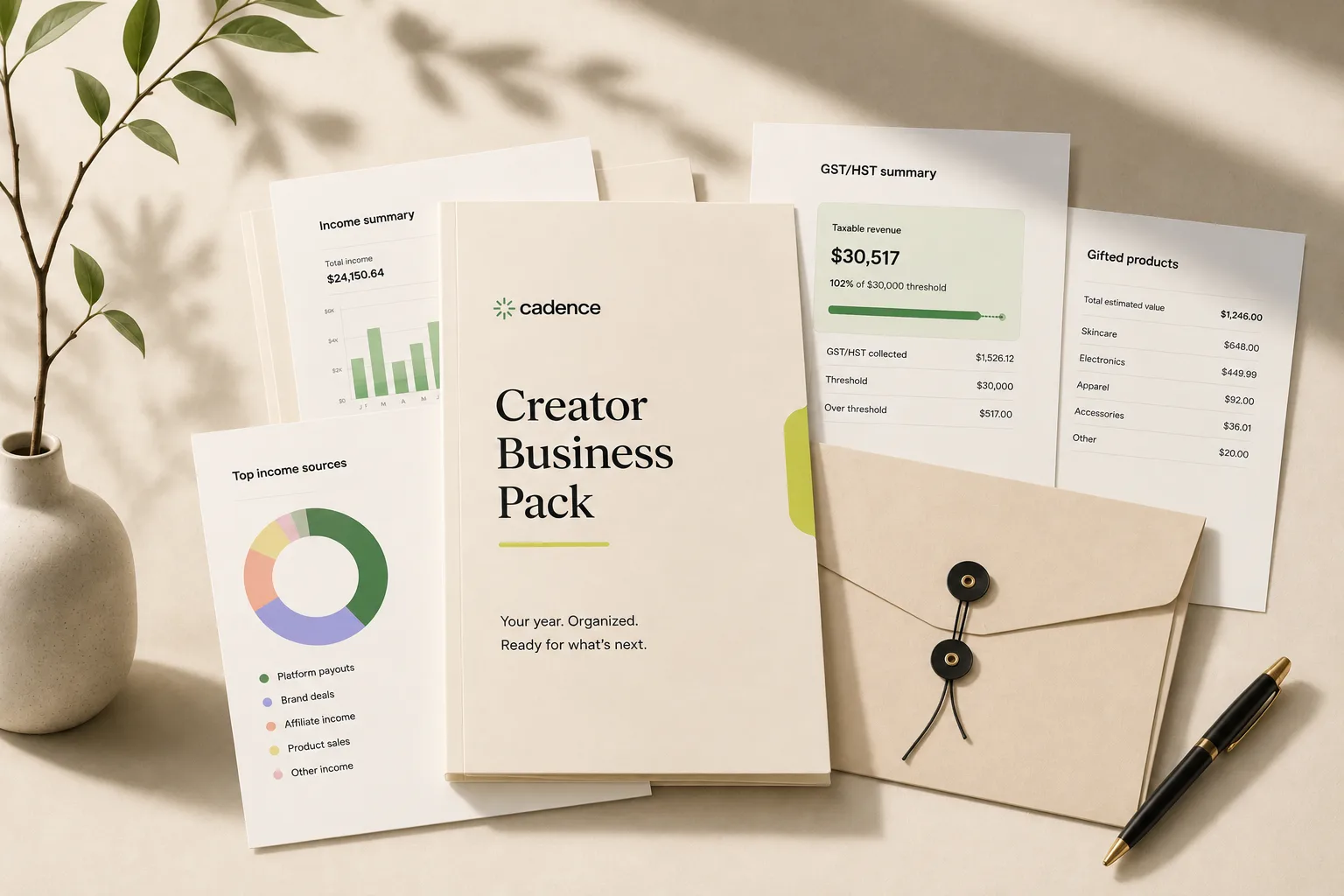
For years, creator income lived in a kind of grey zone — small payouts from foreign platforms, free products from brands, a few sponsored posts a year. That era is over. The Canada Revenue Agency has become noticeably more focused on creator and influencer income, and the audits and review letters arriving in 2025 and 2026 are more pointed than the general business reviews of the past. This guide walks through what's actually changing, what the CRA looks at when it reviews a creator, and the concrete records that keep you on solid ground.
6 yrs
How long the CRA can request records
From the end of the tax year they relate to — longer if fraud or misrepresentation is alleged.
$30K
GST/HST small supplier threshold
Worldwide taxable revenue before expenses. Crossing it without registering is a common audit trigger.
FMV
How gifted products get valued
Fair market value at the time the item is received — what an arm's-length buyer would pay.
Why the CRA is paying more attention to creators
A few forces are pushing creator income up the CRA's priority list at the same time:
- Creator income is large enough to matter — the industry now generates billions in Canada across YouTube, TikTok, Instagram, Twitch, Patreon, OnlyFans, Substack and beyond.
- Platform reporting has improved. Payment processors and ad platforms increasingly share data with tax authorities through OECD-aligned reporting frameworks, and the CRA's data-matching capacity has grown.
- International information sharing — particularly with the IRS and other G20 tax authorities — gives the CRA visibility into foreign-source payouts (AdSense, Stripe, PayPal, OnlyFans) that creators sometimes assume are invisible.
- Public guidance from the CRA on social media influencers, gifted products and creator income has shifted the tone from 'guidance' to 'expectation'.
- Audit casework targeting creators has been reported across multiple provinces, often starting as a review letter and escalating when records are thin.
The practical effect is that the chance of a Canadian creator receiving a review letter, a request for information, or a full audit has gone up noticeably — and the bar for what counts as adequate records has gone up with it.
What 'CRA attention' actually looks like
Most creators will not get a full audit. Far more common are these touchpoints, in roughly increasing severity:
1. Pre-assessment or post-assessment review letter
A letter asking you to substantiate specific items on a return — usually a deduction category or a slice of income. Typically a 30-day response window. Solvable with clean records; painful without them.
2. Limited-scope review
A targeted look at one part of your business — for example, brand deal income, the home office claim, or capital cost allowance on gear. You provide the evidence, the CRA adjusts (or doesn't) and the file closes.
3. GST/HST review
Often triggered when revenue appears to cross the $30,000 small supplier threshold without a corresponding GST/HST registration. Can be its own workstream separate from income tax.
4. Full audit
A comprehensive examination of your books for one or more tax years. On-site or remote. Source documents required for income and expenses. Often kicked off when a review turns up gaps the CRA wants to explore.
What auditors look for in a creator file
The questions the CRA asks creators tend to cluster around a predictable set of risk areas. If your records can cleanly answer each of the questions below, the conversation stays short.
1. All sources of income — not just the obvious ones
The CRA expects to see a complete picture of where money came from. That includes the small streams creators sometimes leave out:
- Platform ad revenue (YouTube AdSense, TikTok Creator Rewards, X ads share, Reels Bonus)
- Subscriptions and memberships (Twitch, Patreon, YouTube Memberships, Substack paid, OnlyFans, Fansly)
- Brand deals — cash and gifted, Canadian and foreign
- Affiliate commissions (LTK, Amazon, ShareASale, Impact, brand-direct)
- Tips, donations, bits and Stars
- Digital product sales (presets, courses, templates, ebooks)
- Live event income (paid streams, ticketed shows, meet-and-greets)
- Reimbursements from brands or agencies
- Any creator-related income paid through PayPal, Stripe, Wise or other processors
Auditors often reconcile the income you reported against bank deposits, PayPal/Stripe activity and (where they have it) platform-level data. Gaps between reported income and deposits are the single most common red flag.
2. Gifted products and barter
This is one of the fastest-evolving areas. The CRA has been increasingly explicit that products received because of creator activity — especially when content is expected — can have a tax consequence at fair market value. Auditors look for:
- A list of significant gifted items received during the year
- Brand, item description and estimated FMV
- Whether content was required or implied
- Date received
- Whether the item was kept, returned or given away
See are gifted products taxable for Canadian creators and influencers? for the full picture.
3. Foreign-source income and currency conversion
AdSense, Twitch, Stripe, PayPal and many brand deals pay in USD. The CRA looks at:
- Whether USD (or other foreign) income was converted to CAD using a defensible rate
- Whether the gross amount earned was reported — not just the net deposit
- Whether any foreign withholding tax was correctly handled
- Whether platform fees and currency conversion fees are recorded as expenses
4. The brand deal paper trail
Brand deals are creator-native and often where records are thinnest. Auditors look for a consistent chain from contract → deliverable → invoice → payment for each deal:
- Contract or written agreement (even if just an email chain)
- Deliverables actually produced
- Invoice issued, with GST/HST charged where applicable
- Payment received and tied to a deposit
- Any gifted product value associated with the deal
Our brand deal recordkeeping checklist covers what to keep behind every sponsored post.
5. Expense reasonableness and business-use portion
The CRA does not generally object to creators deducting business expenses — it objects to expenses that look personal in a business wrapper. Common audit focuses:
- Home office: actual square footage, dedicated use, percentage calculation
- Vehicle: mileage log separating business and personal trips
- Travel: clear business purpose, content produced, not a personal vacation lightly branded
- Clothing: limited to items that are genuinely required for content (rare) — everyday wardrobe is personal
- Meals and entertainment: typically 50% deductible, with attendees and business purpose noted
- Gear: receipts for capital purchases (often CCA), software subscriptions, etc.
See common tax deductions for content creators in Canada for the categories that usually hold up.
6. GST/HST progress and registration
Creator revenue tends to grow quickly. The CRA's data tools make it easier to spot when a creator has crossed the $30,000 small supplier threshold without registering — or registered late. Auditors look at:
- Worldwide taxable revenue by calendar quarter and over four-quarter rolling windows
- Date you crossed (or should have crossed) the threshold
- Whether registration happened on time
- Whether GST/HST was charged to Canadian brands on taxable supplies
- Whether Input Tax Credits claimed are supported by proper invoices
See GST/HST for creators for the full guide.
7. Cash, tips, donations and small payments
Streamers and live creators see a constant trickle of small payments — bits, tips, Stars, donations. The CRA does not need each individual transaction, but it does expect a defensible summary that ties to the platform's payout reports.
8. Hobby vs. business framing
If you're reporting losses year after year while spending on gear and travel, the CRA may question whether the activity is truly a business or a personal pursuit. Indicators of a business include profit motive, commercial conduct, recordkeeping, repeat income and reinvestment.
The records that actually hold up
The CRA's standard is straightforward: keep records that support the income you reported and the expenses you claimed. In creator context, that translates to:
- Bank, PayPal and Stripe statements for each year
- Platform payout reports (YouTube, TikTok, Twitch, Patreon, Substack, OnlyFans, etc.)
- Brand contracts, agreements and email chains
- Invoices issued, with GST/HST line items where relevant
- Receipts for every expense claimed (digital is fine)
- Gifted product log with brand, item, FMV, date and content requirement
- Mileage and travel logs with business purpose noted
- Home office calculation worksheet
- GST/HST filings and the underlying ITC backup
Common ways creator records fall apart
- Reporting net deposits as gross income (missing platform fees, currency conversion, processor fees)
- No record of gifted products even though FMV is significant
- Brand deals tracked in DMs and a notes app — no contract, invoice or evidence
- Mixing personal and business spending in a single bank account
- USD payouts converted with inconsistent or undocumented FX rates
- Crossing the $30K GST/HST threshold mid-year without noticing
- Wardrobe, travel and meals claimed without a business connection
- Capital purchases expensed in full instead of capitalized via CCA
- Receipts scattered across email, Gmail attachments, Drive and a kitchen drawer
- Year-end reconstruction from memory instead of a contemporaneous record
What to do if a CRA letter arrives
- Read the letter carefully — note the deadline, the tax year(s) and the specific items in scope
- Do not ignore it. Silence escalates the file
- Pull the requested records and organize them by year and category
- Loop in your accountant immediately — they handle the response and tone
- Do not send more than is requested, but do not send less
- Keep a copy of everything you provide, with dated cover letter or email
- If you find a real gap in your records, your accountant can advise on voluntary disclosure
How clean records actually change the outcome
The single biggest factor in how a review or audit lands is the quality of contemporaneous records. Auditors are not adversaries by default — they're applying a standard. A creator who can quickly produce a contract, an invoice, a payout report and a matching deposit for a flagged item usually closes the conversation. A creator who has to reconstruct the same item from memory and a screenshot ends up with adjustments, penalties and a much longer file.
The pattern across creator audits is consistent: structure beats volume. Less but organized always wins against more but scattered.
How Cadence helps you stay audit-ready
Cadence is built for exactly this kind of recordkeeping — the messy reality of creator income, where brand deals live in DMs, payouts come from a dozen platforms, gifted products pile up without invoices and receipts arrive by email at midnight.
- Every payout logged with source, gross, net, date, currency and the platform's payout report attached
- Every brand deal tracked from contract through invoice to payment, with files attached
- Gifted products recorded with brand, item, FMV, date received and content requirement
- Expenses categorized and stored with receipts — searchable in seconds
- GST/HST progress visible against the $30K threshold, in real time
- A clean export for your accountant — the same export becomes your audit response if it ever comes to that
Frequently asked questions
Is the CRA actually auditing more creators?
How does the CRA find out about creator income from foreign platforms?
Do I have to report gifted products from brands?
What triggers a CRA creator audit?
How far back can the CRA go?
What's the difference between a review and an audit?
Should I respond to a CRA letter myself or use my accountant?
What is the Voluntary Disclosures Program?
Do I need to track every tip and donation on Twitch or TikTok Live?
Can I claim my camera, lights and computer if audited?
How can Cadence help me prepare for a possible audit?
A note on tax content. This article is general information for Canadian creators, not tax advice. Rules change and your situation is specific to you. Use Cadence to keep clean records, then ask your accountant before filing.
CADENCE
Keep payouts, brand deals, gifted products and tax details in one clean creator business record.
14-day free trial · $19/month after · cancel anytime