When Should a Canadian Creator Incorporate? Benefits, Trade-Offs and Signals It's Time
Most Canadian creators start out as sole proprietors — the income lands in your personal bank account, gets reported on a T2125 with your T1, and the tax bill is whatever it is. That works fine for a long time. At some point, though, the question shows up: should you actually incorporate? This guide walks through the signals that it might be worth it, how a Canadian creator corporation is taxed, the real benefits, and the trade-offs that often get glossed over. Final call belongs to your accountant — your job is to know what questions to ask.
~9–13%
Small business corporate tax rate
Combined federal + provincial on active business income up to the SBD limit (varies by province).
$500K
Federal small business deduction limit
Annual active business income eligible for the low CCPC rate (subject to clawbacks).
$1.5K–$3K
Typical first-year setup cost
Incorporation, minute book, opening accounting and HST registration — varies widely.
Sole proprietor vs. corporation in Canada
As a sole proprietor, you and your creator business are the same legal person. All net business income flows onto your personal T1 and is taxed at your marginal personal rate. There is no separate legal entity, no separate tax return for the business, and no legal shield between your personal assets and your creator activity.
When you incorporate federally or provincially, you create a separate legal person — a corporation. The corporation earns the income, pays its own tax (filing a T2 return), and you only pay personal tax on what you take out as salary or dividends. For most Canadian creator corps, the structure is a Canadian-Controlled Private Corporation (CCPC), which is the form of corporation that unlocks the most useful tax treatment.
Signals it might be time to incorporate
There is no single revenue number that flips the switch. The real test is whether incorporation will pay for itself — in tax savings, liability protection or commercial credibility — relative to the added cost and complexity. The clearer the signals below, the more useful the conversation with your accountant becomes.
- Your net creator income is consistently more than you need to spend personally each year
- You expect predictable six-figure revenue going forward (not a one-off viral year)
- You're signing larger brand contracts, multi-year deals, or working with agencies
- You sell physical product, merch, supplements, courses or anything with liability exposure
- You're paying contractors (editors, managers, photographers, VAs) regularly
- You're building a brand or business beyond your personal channel (a studio, a product line, a co-founded venture)
- You're considering bringing on a partner, investor or co-owner
- You want to smooth income across years instead of riding the marginal-rate rollercoaster
Benefit 1: The small business deduction (and tax deferral)
The biggest financial reason Canadian creators incorporate is the small business deduction (SBD). Active business income earned by a CCPC up to the annual SBD limit (federally $500,000) is taxed at a much lower combined rate — roughly 9% to 13% depending on the province — compared to the top personal marginal rate of around 45–54%.
The key word is deferral. The corporation pays the low rate up front. When you eventually pay yourself the rest out as salary or dividends, you pay personal tax on it and the total combined tax roughly catches up to what you would have paid as a sole prop (this is called integration). The benefit shows up when you do not need all the money personally in the year it is earned. The dollars you leave in the corporation can be reinvested, used to smooth future income, or held for a slower year.
The illustrative numbers above are not advice — provincial rates, dividend treatment and your personal situation all move the math. The point is that deferral only matters if there is income you are not spending. If every dollar of revenue is being withdrawn for rent and groceries, the corp does not save you tax — it just adds paperwork.
Benefit 2: Liability separation
A corporation is a separate legal person. In most cases, contracts you sign on behalf of the corporation create obligations for the corporation — not for you personally. If a brand deal goes sideways, a viewer sues over a product you promoted, or a contractor claim arises, the corp is generally the party on the hook.
That liability shield is most valuable when:
- You sell physical product, food, supplements, merch, courses or anything that could trigger a customer claim
- You sign larger brand or licensing contracts with real teeth (indemnities, exclusivity, IP transfer)
- You hire employees or work with multiple long-term contractors
- You operate a studio space, run live events, or own creator gear with real value
- You hold meaningful retained earnings, IP, or domain/brand assets worth protecting
Benefit 3: Income smoothing and salary vs. dividends
As a sole prop, your taxable income is whatever your business earned. A big sponsorship year pushes you into the top bracket; a slow year wastes lower brackets. As a corp owner, you can choose how much and in what form you pay yourself — salary, dividends, or a mix — and time it to your situation.
Salary
- Deductible expense for the corporation
- Generates RRSP contribution room
- Subject to CPP contributions (both employee and employer side, paid by you)
- Withholdings and T4 reporting required
Dividends
- Paid from after-tax corporate income (no corporate deduction)
- Do not generate RRSP room or CPP credits
- Often simpler administratively — no payroll
- Eligible vs. non-eligible dividend treatment affects personal tax
The optimal mix is personal and depends on your province, your need for RRSP room, CPP philosophy, and the rest of your tax picture. Most creator-corp owners end up with some mix of both. Your accountant works this out each year.
Benefit 4: Commercial credibility
Some opportunities get easier with a corporation behind them. Agency contracts, brand licensing deals, banking and credit facilities, publisher partnerships and equity investment all tend to assume there is a corporate counterparty. A corp number on an invoice, a registered HST number and a clean set of books make you easier to do business with.
This is not a huge benefit on its own — plenty of successful creators operate as sole proprietors for years — but combined with the tax and liability benefits, it nudges the decision over the line.
Benefit 5: Retained earnings and an investment runway
Money left inside a CCPC can be invested. Passive investment income inside a corp is taxed at relatively high rates, but it still grows on a tax-deferred basis relative to having paid full personal tax on the way in. For creators with a volatile income curve, the corp becomes a financial buffer — capital that funds a slower year, a new studio, an editor hire, or a product launch without forcing a personal withdrawal.
The trade-offs (what incorporation actually costs you)
Incorporation is not free. The honest cost is a mix of money and ongoing compliance weight. The income you earn has to comfortably absorb both.
- Setup cost: federal or provincial incorporation, NUANS name search, minute book, share structure — usually $1,500–$3,000 with a lawyer or accountant
- Annual T2 corporate return and financial statements — typically $1,500–$5,000+ depending on activity
- Bookkeeping discipline must be cleaner — separate corporate bank account, no commingling of personal and business spending
- Annual corporate return filing (provincial), and director/registered office maintenance
- Payroll setup and source deductions if you take salary
- HST/GST registration and quarterly or annual filing, depending on revenue and election
- Director responsibilities (source deductions, HST, certain wages — personally liable)
- Winding up a corp later costs money too if you decide to dissolve
A common rule of thumb: if incorporation will not save you at least its annual cost in tax or reduce real liability you actually face, it is probably premature.
Worked example: a creator who shouldn't incorporate yet
A part-time Canadian creator earns $42,000 in net creator income on top of a $65,000 day job. Everything she earns is spent on living costs and gear. Her only contracts are small brand deals with minimal risk. She does not sell physical product.
- 70%Personal spending / living costs
- 25%Gear, software, expenses
- 5%Discretionary / savings
For her, incorporation would add $2,000–$4,000/year of compliance cost with almost no tax deferral benefit (she needs the money personally) and no meaningful liability exposure to shield. Staying a sole proprietor with clean records is the right answer — for now.
Worked example: a creator who probably should
A full-time Canadian YouTuber and Instagram creator earns $285,000 in net business income. He needs about $110,000 personally to live comfortably. He has long-term brand contracts with two beauty companies, sells a $97 preset pack on Gumroad, runs a small Patreon, and has just signed a deal to develop branded merch.
- 39%Personal need (would be withdrawn either way)
- 49%Deferrable surplus (stays in corp at low rate)
- 12%Reserved for growth / hiring / next year
In a corp, the ~$175,000 he does not need personally is taxed at the low SBD rate instead of his top personal marginal rate — a meaningful deferral. The corp also becomes the counterparty on the merch deal, which carries real product liability. The annual compliance cost is small relative to the savings and the protection. Incorporation is almost certainly the right move.
Federal vs. provincial incorporation
You can incorporate federally (under the Canada Business Corporations Act) or provincially. Federal incorporation gives you stronger name protection across Canada but generally requires extra-provincial registration in the province(s) you operate in. Provincial is often cheaper and simpler if your business operates in one province. For most solo creators, provincial is the common starting point. Your accountant or business lawyer will recommend based on your situation.
What changes operationally on day one
- Open a separate corporate bank account in the corporation's legal name
- Stop commingling — every personal expense flows out via salary, dividend or shareholder loan tracking
- Re-register HST/GST under the corporation if you were already registered personally
- Update brand contracts and platform payout details to the corporation's name and number where appropriate
- Move recurring software, gear and contractor invoices into the corporation's name
- Set up a payroll account with CRA if you'll take salary
- Decide on a fiscal year-end with your accountant (does not have to be December 31)
- Start a corporate bookkeeping file from day one — not retroactively at year-end
GST/HST and incorporation
GST/HST is a separate question from incorporation, but they often come up together. If you were already registered personally, you typically de-register the personal account and register the corp. If you crossed (or are about to cross) the $30,000 small supplier threshold, registration becomes mandatory regardless of structure. See the GST/HST for creators guide for more.
Common mistakes when creators incorporate
- Incorporating too early, before income justifies the compliance cost
- Continuing to run personal spending through the corporate bank account ('I'll fix it at year-end')
- Not tracking shareholder loan balances — owing the corp money has tax consequences
- Forgetting to file the annual corporate return (separate from the T2 tax return)
- Drawing money without a plan for salary vs. dividends until tax time
- Treating the corp's retained earnings as personal savings
- Skipping a minute book and proper share structure to save a few hundred dollars
- Not updating contracts, platform accounts and HST registration after incorporating
What to bring to the incorporation conversation
The more concrete your numbers, the more useful a paid consult will be. A creator-savvy accountant can model the actual deferral benefit and the breakeven point against the compliance cost — but only with real data in hand.
- Last 12–24 months of creator income, summarized by source (AdSense, brand deals, affiliate, subs, gifted FMV, etc.)
- Same period of business expenses by category
- Your personal spending need — how much you actually pull out of the business each year
- Forward projection for the next 1–2 years (realistic, not aspirational)
- Major upcoming contracts, product launches or liability exposures
- Any partners, co-owners or investors in the picture
- Existing GST/HST registration status
How Cadence helps
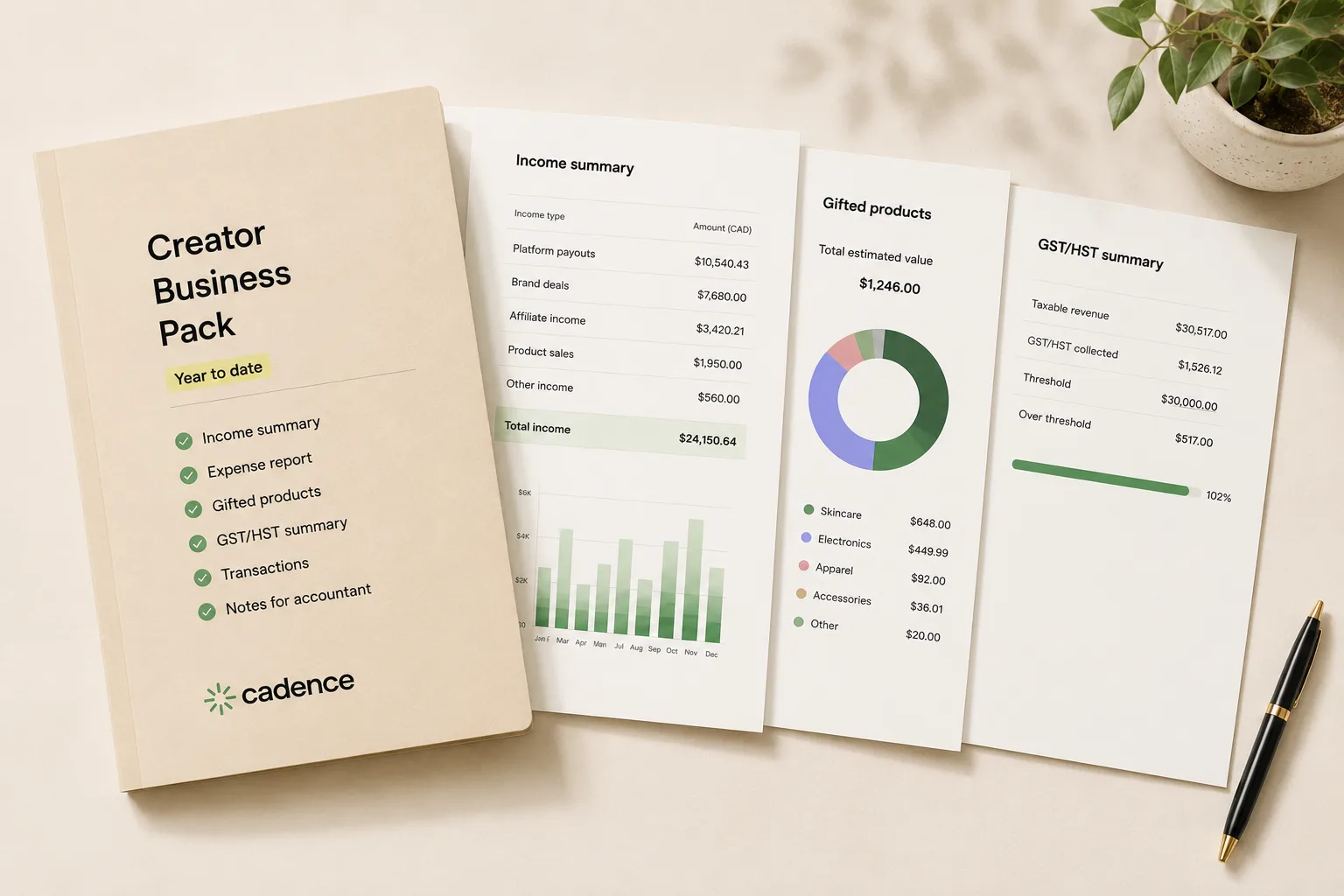
Whether you stay a sole prop or eventually incorporate, the underlying business records look the same: payouts in, expenses out, brand deals tracked, gifted products noted, GST/HST progress visible. Cadence keeps that record clean so the structural decision becomes a numbers conversation with your accountant — not a guess.
- See net creator income trend across months and years — not just totals
- Track each income stream by source so deferral math is easy to model
- Keep contracts, invoices and gifted product evidence with the records
- Watch your GST/HST threshold progress before and after incorporating
- Export a clean summary for the consult that decides this for real
Frequently asked questions
At what income level should a Canadian creator incorporate?
Does incorporating actually save me tax?
What is a CCPC?
Should I pay myself salary or dividends?
Federal or provincial incorporation?
How much does it cost to incorporate as a creator?
Does incorporating protect me from being sued personally?
Can I incorporate myself online without an accountant or lawyer?
What happens to my HST registration if I incorporate?
Can I incorporate and keep being paid personally on existing brand deals?
Does incorporating affect my CPP and RRSP?
Is incorporation reversible?
A note on tax content. This article is general information for Canadian creators, not tax advice. Rules change and your situation is specific to you. Use Cadence to keep clean records, then ask your accountant before filing.
CADENCE
Keep payouts, brand deals, gifted products and tax details in one clean creator business record.
14-day free trial · $19/month after · cancel anytime